
How Technology Helps Football Referees Make the Right Decisions
By HeroPredict Editor
Expert Sports Analyst
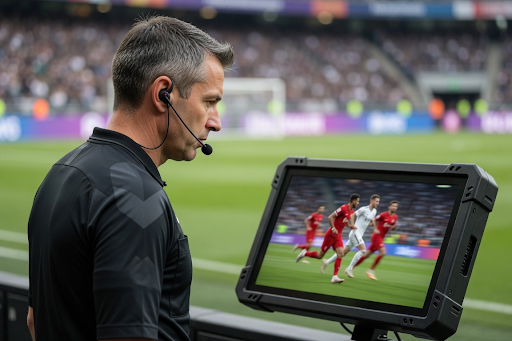
In the final minutes of a decisive match, a single decision can determine the outcome for an entire team. Traditionally, referees had limited support when making such calls, with the responsibility resting almost entirely on the officials on the pitch. Today, technology can share some of that burden. Modern systems provide additional information that can help referees make more accurate and fair decisions. This article examines how technology has changed the role of football officials and the way crucial decisions are made.
The Burden Referees Carried Before Technology
Throughout much of football's history, referees faced the enormous challenge of trying to follow every important aspect of a fast-moving match. Officials had to monitor play in real time while watching for fouls, questionable goals, off-the-ball incidents, and other potential violations. Many incorrect decisions were not the result of negligence but simply the limitations of human perception. The task became even more demanding as the pace of football increased and players became faster and more athletic.
Football's governing bodies gradually recognized that technological solutions were becoming a necessity rather than a luxury. While fans can now follow individual decisions and match developments through platforms such as (Arabic: MelBet للمراهنات), referees themselves needed tools capable of providing additional information in real time. Digital platforms can offer live statistics and other information reflecting events on the pitch. Meanwhile, dedicated officiating technologies began giving referees additional support when making important decisions.
|
Challenge for the Referee |
How Technology Addresses It |
|
Extremely fast play |
Slow-motion replay of incidents |
|
Limited viewing angles |
Multiple cameras covering the pitch |
|
Close offside decisions |
Automated lines for greater precision |
|
Questionable goals |
Goal-line sensors and camera systems |
|
Immediate pressure |
Additional time and information before the final decision |
Tools That Changed the Decision-Making Process
Technology was not introduced to replace referees but to support their judgment and give them greater confidence when making difficult calls. Football organizations have adopted a range of tools, each with a specific purpose during a match. Some review major incidents, while others resolve situations involving extremely small margins. The most important technologies that have reshaped the referee's role include:
- Video Assistant Referee systems for reviewing goals, red-card incidents, and other specified match-changing situations.
- Goal-line technology that can confirm whether the ball has completely crossed the line within seconds.
- Semi-automated offside systems that help determine player positions with high precision.
- Communication headsets connecting the refereeing team in real time.
- Referee watches that can receive an immediate signal from goal-line technology when a goal is detected.
This greater precision has also changed how spectators follow matches. Fans can examine match information using tools such as (Arabic: برنامج MelBet), which brings statistics and results together on a mobile device. Such digital services should remain tools for entertainment and understanding rather than promises of any guaranteed outcome. No matter how detailed the statistics become, football always retains an element of uncertainty.
The integration of these technologies has helped reduce some of the intense disputes historically associated with major refereeing errors. Teams affected by an obvious mistake may now have the incident reviewed before play continues. As these systems have developed, some forms of post-match controversy have been reduced, contributing to a fairer game while preserving its competitive excitement.
Initially, many people resisted the introduction of these tools because they feared they would slow down matches. In practice, review times vary depending on the complexity of an incident, and some decisions can still require significant checks. Nevertheless, many supporters have come to accept limited interruptions when they contribute to more accurate decisions. At the highest levels of football, technological officiating systems have become increasingly common.
As these tools have spread through major competitions, elements of the same technology have also appeared at lower levels where the necessary infrastructure and funding are available. Growing confidence in technological assistance has encouraged more competitions to explore its use. Greater consistency and fairness in refereeing have become important objectives across modern football.
Finding the right balance between preserving the excitement of the game and using technology remains an ongoing challenge. Too many or overly lengthy reviews can interrupt the rhythm and emotional flow of a match. For this reason, review systems such as VAR are generally restricted to defined categories of significant incidents. The objective is to allow technology to serve the game without unnecessarily dominating it.
How These Technologies Work on the Pitch
Before examining the individual systems, it is worth understanding the scale of the problem they are designed to address. As players have become faster and tactics more sophisticated, detecting subtle infringements can be increasingly difficult. A split-second movement or brief contact may be hard to assess accurately with the naked eye. The value of each technology becomes clearer when we look closely at how it works.
Video Assistant Referee Technology
Additional match officials monitor video feeds showing incidents from multiple camera angles. When a reviewable incident occurs, the video officials can examine the footage and communicate relevant information to the referee on the pitch. Depending on the type of incident, the referee may also conduct an on-field review using a pitchside monitor. The referee retains responsibility for the final decision. This combination of technological evidence and human judgment is central to how VAR operates.
Goal-Line Technology
Goal-line technology uses cameras or other approved tracking systems to continuously monitor whether the ball has completely crossed the goal line. When the system detects a goal, a signal is transmitted to the referee's watch almost immediately. Unlike many subjective refereeing decisions, the question here is narrowly defined: whether the entire ball crossed the entire line. The technology has therefore helped resolve one of football's historically controversial types of decisions.
The strength of these systems lies in their combination of speed and precision. They can process information in fractions of a second and provide officials with evidence that would be extremely difficult to obtain through human observation alone. At the same time, the technology is designed to support the officiating process rather than eliminate the referee's broader role. Technical precision and human judgment therefore continue to work together.
Semi-Automated Offside Systems
Specialized cameras track the positions of players and the ball repeatedly throughout play. The resulting data can be used to establish relevant player positions and assist officials in determining whether an offside offence occurred. The information is sent to the video officiating team, which verifies the situation before the decision is communicated. This process can reduce the time and uncertainty involved in extremely close offside calls.
Setting Limits on Digital Entertainment
Gambling should fundamentally be treated as a form of entertainment. People who choose to participate should establish limits before gambling rather than after problems emerge. Responsible gambling services may provide tools such as self-exclusion, deposit limits, session controls, and reminders to take breaks. Age restrictions and other legal requirements vary by jurisdiction, so users should always follow applicable local laws and use appropriately licensed services where gambling is permitted.
People who gamble should remember that statistics are tools for understanding probabilities, not guarantees of financial gain. It is possible to analyze team performance carefully, but no analysis can make the outcome of a football match certain. If gambling begins to replace a person's enjoyment of sport or causes financial or emotional pressure, stepping away from gambling is the more responsible choice.
Moderation is therefore fundamental when gambling is associated with sport. Money needed for housing, food, bills, savings, or other essential expenses should never be used for betting. Establishing firm financial and time limits can help keep gambling separate from essential spending and preserve sport primarily as a source of entertainment.
How Greater Accuracy Affects the Game and Its Fans
The impact of technology has extended beyond referees to spectators as well. Fans can often see replays and explanations related to the same incidents being reviewed by match officials. This greater visibility can help people understand why certain decisions are made and can strengthen confidence in the officiating process. To make better use of this more transparent viewing experience, fans can follow a few simple principles:
- Watch the replay before deciding whether you agree with a call.
- Learn the rules governing each technology so you understand when and why it is used.
- Compare the referee's decision with the available footage before reaching a conclusion.
- Avoid reacting too quickly, as some reviews require time to assess properly.
- Enjoy the broader experience of the match rather than focusing exclusively on refereeing mistakes.
Over time, spectators have become more accustomed to short periods of technological review. Rather than simply interrupting a match, these moments can sometimes create additional anticipation and tension as supporters wait for the final decision. What was initially viewed primarily as a disruption has, in some situations, become another dramatic element of the modern football experience.
In the past, a major refereeing error could affect discussions long after the final whistle. Players and supporters naturally wanted matches to be decided as fairly as possible. Technology cannot eliminate every disputed judgment, particularly when the laws of the game still require subjective interpretation, but it can provide officials with additional evidence before certain crucial decisions become final.
Greater access to replays and technical explanations has also changed the way supporters discuss refereeing. Instead of relying entirely on an initial impression, viewers can examine an incident again, consider the relevant rule, and debate whether the final interpretation was appropriate. Technology has therefore added a new dimension to the relationship between spectators, referees, and the laws of the game.
Toward a Fairer Football Pitch
Technology has not eliminated the referee's role. Instead, it has effectively provided officials with additional eyes capable of detecting details that can be extremely difficult to see in real time. Through video review, goal-line technology, and increasingly sophisticated offside systems, football has gained tools that can make important decisions more accurate.
For supporters in Yemen and elsewhere, these developments can make crucial moments easier to understand and help create a greater sense of fairness. Yet technology remains a tool designed to serve football rather than replace its human element. The challenge for the future is to continue improving accuracy while preserving the speed, emotion, unpredictability, and enjoyment that make the game compelling.