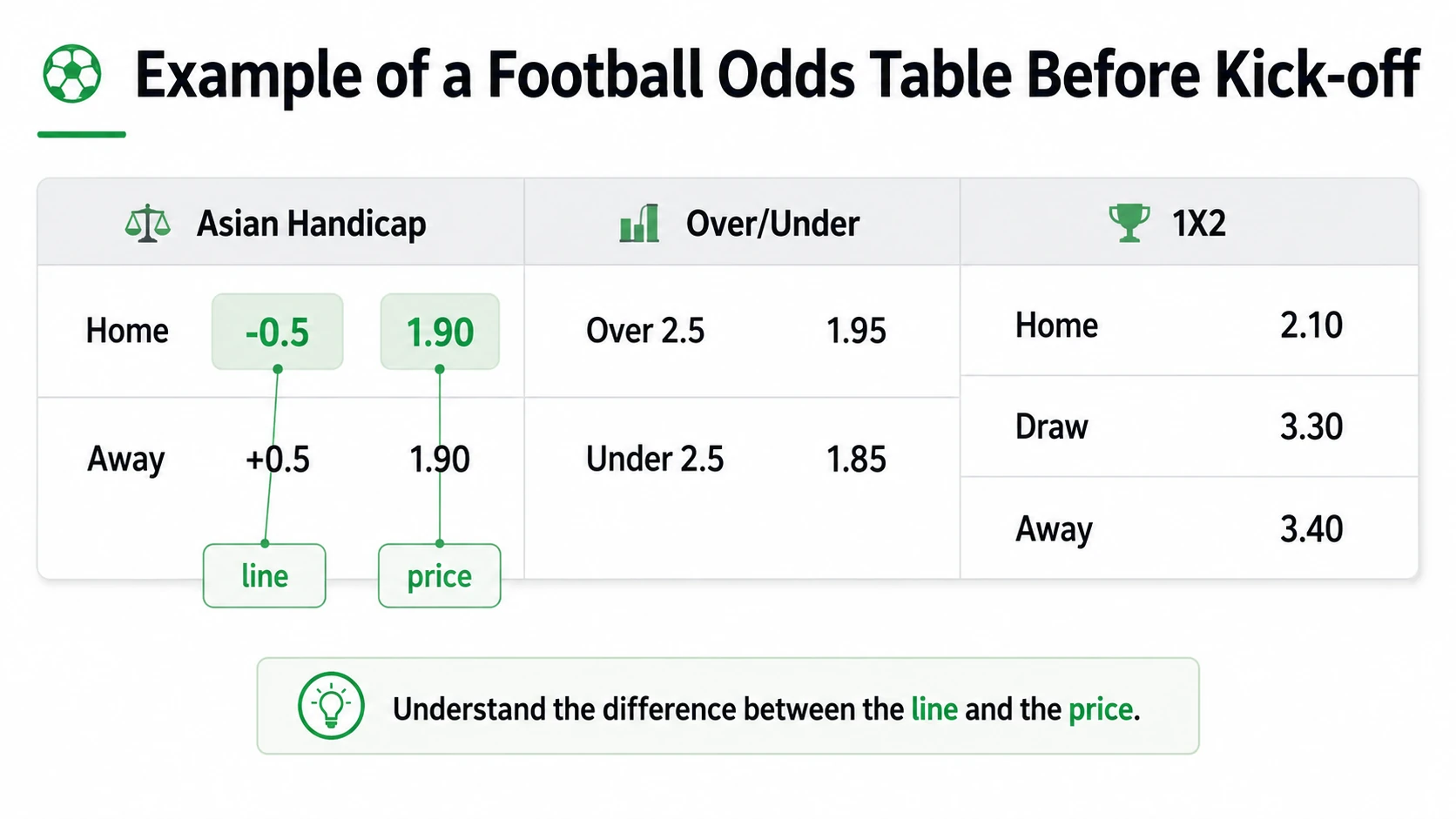
A football match may show the home team at -0.5, an over/under line of 2.5 and three separate 1X2 prices. When those numbers change before kick-off, it is easy to confuse a movement in the betting line with a simple change in price.
Reading football odds correctly starts with one rule: identify what each number represents before comparing it. The line defines the condition of the selection, while the price shows the potential return. Once that distinction is clear, pre-match movements become much easier to follow.
Example of a football odds table before kick-off
Separate the betting line from the price
An odds table normally contains two different types of information: the betting line and the price.
The line defines what must happen for the selection to succeed. Examples include a home team at -0.5 on the Asian handicap, Over 2.5 total goals, or one of the three possible results in the 1X2 market.
The price shows the potential return if the selection wins. It may appear as 1.90, 0.90, -1.11 or another equivalent figure depending on the format being used.
For example, “home team -0.5 at 1.90” contains two separate numbers. The -0.5 is the handicap line, while 1.90 is the Decimal price. If the handicap changes from -0.5 to -0.75, the line has moved. If it remains at -0.5 but the price changes from 1.90 to 1.82, only the price has changed.
This distinction matters because a higher potential return is not automatically better when the settlement conditions are different.
What the three main football markets tell you
Most pre-match analysis begins with the Asian handicap, over/under and 1X2 markets. Each describes the match from a different angle.
Asian handicap
The Asian handicap reflects the expected gap between the two teams. A stronger side may be listed at -0.5, -0.75 or -1.0, while the opponent receives the corresponding positive handicap.
A -0.5 selection needs the team to win. Whole-number and quarter lines can settle differently, so the exact handicap must be checked before comparing prices.
For pre-match reading, the key question is whether the handicap itself has moved. A shift from -0.5 to -0.75 represents a stronger assessment of the favourite than a simple price change on the same -0.5 line.
Over/under
The over/under market reflects the expected total number of goals scored by both teams. At 2.5 goals, three or more goals settle the Over, while two or fewer settle the Under.
A move from 2.5 to 2.75 is different from the Over 2.5 price falling from 1.95 to 1.80. The first changes the goal line and its settlement conditions; the second changes only the price.
1X2
The 1X2 market covers the three possible match results: home win, draw and away win. It helps show which team is considered more likely to win, but it should not be compared directly with an Asian handicap price because the markets have different outcomes.
Use one consistent odds table
Before comparing movements, use a table that clearly shows the fixture, kick-off time, market, line and price. For a consistent view of the main pre-match markets, readers can use Keonhacai5 to compare Asian handicap, over/under and 1X2 prices across upcoming fixtures.
The aim is not simply to find the largest number. A useful comparison must involve the same match, the same market and the same line.
For each fixture, record the main lines, their prices and the time checked. Prices may change after line-ups, injuries or tactical information become public.
Compare the opening line with the current line
The opening line is the first widely available assessment of a match. The current line is the latest figure shown before kick-off.
Suppose a home team opens at -0.5 and later moves to -0.75. This indicates that the assessment has shifted towards the home side. It does not guarantee a comfortable win, but it shows that the expected gap between the teams has changed.
Difference between a line movement and a price movement
A price can move without the line changing. The handicap may remain at -0.5 while the home price shortens from 1.95 to 1.80. In that case, the condition of the selection is unchanged, but the potential return has fallen.
The same principle applies to totals. Over 2.5 may move from 1.95 to 1.80 while the goal line remains fixed. If the market changes from 2.5 to 2.75, the settlement condition has also changed.
For match analysis, comparing the same line at two different times is more useful than judging a fixture from one isolated price.
Check whether team news explains the movement
Odds movements are easier to interpret when they follow confirmed information. A starting line-up can affect a match more than recent results alone.
The absence of a first-choice goalkeeper, holding midfielder or main striker may alter the team’s approach. The replacement matters too: a regular substitute may fit the system, while an unfamiliar player could force a tactical change.
Rotation is another factor. Clubs competing in several tournaments may rest important players before a higher-priority fixture. A price that looked reasonable a day earlier may move quickly once the team sheet confirms a weakened starting eleven.
Weather, pitch conditions and scheduling pressure can also affect expectations. Any movement should be treated as new information, not proof of the final result.
Make sure the odds format is the same
The same underlying price may appear differently in Decimal, Hong Kong, Malay, Indonesian, American or Fractional format.
One source may show 1.80 while another shows 0.80. Those figures can represent the same value if the first uses Decimal and the second uses Hong Kong odds.
Before comparing two sources, convert both prices into the same format. Decimal is often the easiest reference because it shows the total return, including the original amount.
Readers using different regional displays can consult this odds format conversion guide for the main formulas and worked examples.
Do not compare different lines as if they were identical
A higher price does not necessarily mean a better option when the line is more difficult.
Consider these two selections:
- Home -0.5 at 1.80.
- Home -0.75 at 2.05.
The second price is higher, but it also requires a stronger result. A one-goal home victory fully settles -0.5 as a win, while -0.75 produces only a half win.
The same issue appears with totals and alternative handicaps. Always confirm that the match, market and line are identical before comparing two prices.
A six-step pre-match checklist
Simple checklist for reading football odds before kick-off
Before drawing a conclusion from an odds table, follow these six steps:
- Confirm the fixture and kick-off time.
- Identify the market being viewed.
- Separate the betting line from the price.
- Check which odds format is being used.
- Compare the opening and current line.
- Review confirmed team news before drawing a conclusion.
This process does not predict the result. It simply reduces the risk of reading an odds table incorrectly.
Common mistakes to avoid
The most common error is comparing prices without checking whether the line is identical. A price of 2.00 on -0.75 cannot be compared directly with 1.80 on -0.5 because the settlement conditions are different.
Another mistake is treating every shortening price as a prediction of the final result. Odds reflect the information and assessment available at that moment; they do not guarantee what will happen on the pitch.
It is also easy to confuse a change of display with a genuine movement. Hong Kong 0.90 and Decimal 1.90 are equivalent, so switching between them does not mean the price has increased.
Conclusion
Reading football odds before kick-off begins with separating the betting line from the price. The Asian handicap, over/under and 1X2 markets describe different outcomes, while the odds format only changes how the price is displayed.
A practical approach is to compare the same line at two different times, check whether confirmed team news supports the movement and avoid treating a shorter price as certainty. Odds provide information rather than guarantees, so any participation should remain within a fixed entertainment budget.