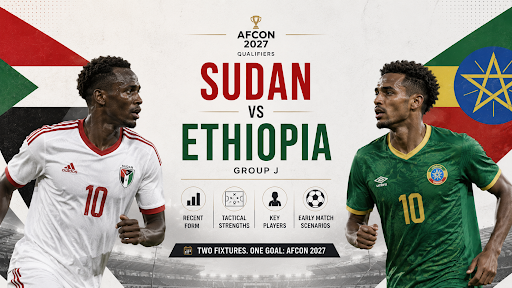
Sudan vs Ethiopia Is the Group J Matchup That Could Shape Both Campaigns
Sudan and Ethiopia are guaranteed to meet home and away during AFCON 2027 qualifying, although CAF had not published the precise order of the Group J fixtures in its official draw announcement as of August 28. That distinction matters before treating either meeting as a confirmed September opener.
The broader competitive picture is already clear. Senegal, Mozambique, Sudan and Ethiopia will each play six group matches, with the top two qualifying for the 2027 finals. Sudan sat 117th in FIFA’s July 20 ranking and Ethiopia 143rd. Ethiopia arrives after a clean 4-0 aggregate preliminary-round win, while Sudan has recent evidence of staying competitive against stronger African sides.
Ethiopia finally produced goals without giving the tie away
Ethiopia’s preliminary-round win over São Tomé and Príncipe gave the attack a useful starting point.
Kenean Markneh opened the first leg in the 22nd minute. Abel Yalew made it 2-0 nine minutes later and completed his brace in the 78th minute, giving Ethiopia a 3-0 advantage. Chernet Gugsaa then scored after seven minutes of the return leg as Ethiopia won 1-0 and advanced 4-0 on aggregate.
The opponent level matters, but so does the structure of the result. Ethiopia scored in both legs, found goals from three players and did not concede.
That does not mean the same chance volume will appear against Sudan. It means the next coaching staff selection has recent competitive evidence to work with rather than relying only on older World Cup qualifying performances.
Sudan has already shown how uncomfortable it can make stronger teams
Sudan’s recent profile is built more around resistance than attacking volume.
In March 2025, Sudan held Senegal 0-0 in Benghazi during World Cup qualifying. Senegal dominated possession, but CAF described Sudan as disciplined and dangerous on the counter. Earlier in that campaign, Sudan had beaten DR Congo 1-0.
The evidence continued at AFCON 2025. Sudan reached the round of 16 and shocked Senegal with a sixth-minute opener from Aamir Abdallah before losing 3-1 to the eventual champion.
Those matches help explain the likely challenge for Ethiopia. Sudan has experience sitting compactly, accepting long spells without the ball and waiting for transition opportunities. Ethiopia will need more patience than it required against São Tomé and Príncipe.
The first tactical question is how high Ethiopia dares to push
Ethiopia’s width can become both an attacking tool and a defensive risk. Advancing both full-backs can stretch a compact opponent, but the spaces left behind become valuable when possession changes.
The safer pattern may involve one full-back advancing while the opposite side holds a stronger rest-defence position. That gives Ethiopia another body around midfield if Sudan wins the ball.
Supporters comparing recent form with Ethiopian betting markets should treat the price as one more piece of information rather than a replacement for squad and venue confirmation. A Sudan favorite line would make more sense if the relevant fixture is confirmed on nominal home terms, although Sudan has had to stage competitive matches outside the country during the current conflict. The draw becomes more interesting if Ethiopia protects central spaces and prevents Sudan from creating clean transition attacks. Totals prices will depend heavily on whether Ethiopia can attack without turning every turnover into an open field. Any early market can still move when the venue, squad lists and player availability become official.
The venue point is particularly important here. “Home” does not automatically mean a familiar Sudanese stadium under current conditions.
Yalew enters Group J with the strongest fresh scoring evidence
Abel Yalew has earned attention after scoring twice in the preliminary first leg. His next challenge is different.
Against a deeper defensive line, Ethiopia may ask its striker to do more than finish chances. Holding possession, drawing fouls, and occupying center-backs can give midfielders time to advance.
Kenean Markneh and Chernet Gugsaa also arrive with competitive goals from the preliminary tie. Neither should be treated as an automatic starter before the squad is announced, but their March performances provide verified recent evidence.
For Sudan, Aamir Abdallah’s early strike against Senegal at AFCON 2025 is another reminder that the team can attack before an opponent settles. Ethiopia cannot spend the opening ten minutes merely assessing the shape.
Three scorelines create three completely different tactical tests
A 0-0 match after an hour probably suits Sudan more than an open exchange. Ethiopia would then face the decision of whether one point is acceptable or whether to increase numbers ahead of the ball.
A Sudan opener creates the hardest scenario. Ethiopia would need to break down a team already comfortable defending compactly.
An Ethiopian first goal changes the problem in the opposite direction. Sudan would have to take more possession and leave its defensive shell, potentially producing space for Yalew, Markneh or another transition runner.
Those scenarios should also shape how an adult supporter approaches a bet market once official fixture details are available. Moneyline movement can reflect a venue announcement, squad absence or simply additional liquidity rather than a mysterious change in team quality. A live price that shortens after sustained possession should still be checked against shot quality and penalty-area entries. Territory alone does not guarantee a goal. Low-scoring markets look plausible from the current evidence, but that assessment should be updated once lineups and venue conditions are known.
A strong prediction before those details would be false precision.
Mohamed Mustafa matters, but Sudan’s defense is collective
Sudan goalkeeper Mohamed Mustafa was involved in the 0-0 draw with Senegal, although his performance should not be exaggerated. CAF recorded an early mistake that almost presented Senegal with a chance before he recovered.
The more important detail was the structure in front of him. Sudan restricted a stronger opponent while remaining dangerous on the counter.
That collective organization is what Ethiopia must solve. Breaking one defensive line is not enough if Sudan keeps midfield distances tight and forces attacks toward low-percentage crossing positions.
Set pieces could therefore carry unusual weight. In a game with limited open-play chances, one free kick or second ball may decide the points.
Six games leave little room for a bad direct matchup
Senegal enters Group J as the reigning African champion and was ranked 18th by FIFA in July. That establishes a clear benchmark at the top end of the group.
Mozambique adds another competitive layer rather than allowing the section to split neatly into favorites and outsiders. For Sudan and Ethiopia, their two direct meetings may therefore determine how much pressure they carry into the Senegal and Mozambique fixtures.
CAF has scheduled Matchdays 1 and 2 between September 21 and October 6, 2026, Matchdays 3 and 4 from November 9–17, and the final two rounds from March 22–30, 2027.
The next useful update is not a stronger score prediction. It is CAF’s fixture notice: exact date, venue, kick-off time and confirmed squad availability.